How to Get a Argent Badge Again

Original painting of the No. one Schoolhouse of Technical Preparation badge, Royal Air Strength. The beech tree represents the wood at RAF Halton where the school was first formed.[i] Annotation the approval signature past Male monarch George VI. The motto translates equally Growing we learn.[two]
Heraldic badges of the Royal Air Force are the insignia of certain commands, squadrons, units, wings, groups, branches and stations within the Imperial Air Force. They are also commonly known as crests, specially by serving members of the Royal Air Force, but officially they are badges. Each badge must exist approved by the reigning monarch of the time, and as such will either have a King's or Queen'southward Crown upon the superlative of the badge, dependent upon which monarch granted blessing and the disbandment date of the unit.[note 1] [3] The approval process involves a member of the College of Artillery (the Inspector of RAF Badges) who acts equally an informational on all matters pertaining to the design and suitability of the insignia and motto.
Some badges that have been approved past either King Edward VIII or George VI volition accept merely adopted the Queen's Crown subsequently her accretion in 1952. The number of badges that Rex Edward VIII signed is express due to his short time on the throne.
History [edit]
The first badge adopted by the RAF was the official Royal Air Force Bluecoat, and was instituted on one August 1918, some four months after the germination of the Regal Air Strength.[four] Afterwards, units and squadrons adopted their own insignia and used them in a way similar to a regimental colour. For some squadrons, their unofficial badges would pre-date the formation of the RAF. Most Royal Flying Corps squadrons during the Offset World War would pigment their squadron keepsake (or device) upon a shield to hang upward in the mess or squadron bar. They often viewed themselves as 'knights of the air' and the badge helped foster a sense of identity on and with the squadron.[v]
In the case of 100 Squadron, their badge incorporated a skull and crossbones insignia that had been liberated from a French "house of ill-repute" in 1918.[half-dozen] Some mascots were back formations from the badge rather than supplying the idea for the badge. No. 234 Squadron had "..a dragon rampant, with flames issuing from the mouth.." canonical by King George VI in August 1940.[seven] Past 1956, the squadron were at RAF Geilenkirchen in Federal republic of germany and were looking for a suitable mascot for their squadron based on its dragon insignia; they reportedly would settle for an iguana.[8] [nine]
Until the early on 1930s, squadrons and units would utilise their own informal badges and insignia.[10] In 1935, the process of formalising the badges was undertaken whereby an official heraldic approval would be granted by the ruling monarch of the time. The whole design process would ultimately rest with the Chester Herald as the Inspector of RAF Badges. This has changed over the years and has been filled by Clarenceux Male monarch of Arms and by the Surrey Herald of Arms Extraordinary.[11] The Inspector of RAF Badges would liaise with squadrons and units to finalise designs that would reverberate already adopted insignia or to utilise something suitable to recognise the squadron or unit.[annotation 2] [12] [thirteen] An Air Ministry Order (A.eight/1936) was issued in Jan 1936 and detailed the criteria for badges and their ultimate blessing via the Chester Herald and the king.[14] In June of the same twelvemonth, King Edward VIII canonical the first raft of badges for numbers 4, 15, xviii, xix, 22, 33, 201, 207, 216 and 604 Squadrons.[15]

Sign outside the station headquarters at RAF Cosford; the station badge is at the bottom
When a new bluecoat is granted an approval by the reigning monarch, the unit or squadron is presented with the original goatskin painting signed by the monarch and copies will exist made and drawn to the standard prepare by the original.[thirteen] The Inspector of RAF badges keeps copies which are registered in large albums known as "The inspectors ordinary copies".[16] A badge is 'ensigned' on the acme with either a King's or a Queen's Crown; this depends on which particular monarch was ruling at the time.[17] For Edward VIII and George VI, a King's (or Tudor Crown) is used.[18] The number of badges approved past Edward VIII are small in number; the period between his accession to the throne and his abdication lasted only 11 months. As the first batch of badges for the approvals procedure was completed in July 1936, about badges were approved by his ii successors (Male monarch George 6 and Queen Elizabeth 2).[19] The granting of a badge is a personal honour between the monarch and unit that has been awarded the bluecoat, and is not conferred upon the RAF as a whole.[v]
Any serving unit could utilize for a bluecoat and some did, whereas others did not or had their application thwarted by fourth dimension; in the case of No. 273 Squadron, their badge was still pending final approval afterwards several re-submissions when it had been rejected by Air Command South-E Asia and past the Inspector of Badges. This hinged upon the proposed apply of an Asian Fylfot, which strongly resembles a Swastika. The squadron was disbanded in 1945 earlier being issued a badge due to doubtfulness on a design or motto.[20] A entrada in 1996 to have the badge issued for the veterans of No. 273 Squadron was unsuccessful despite the backing of several MP's, and information technology was finally awarded to the squadron association in principle.[21] If a unit of measurement could non adhere to the qualifying heraldic criteria, then a badge would not be issued. Where badges had not been issued or even practical for, a badge of a higher authority could be used instead (RAF Cowden in East Yorkshire used the Strike Command badge equally it was an air weapons range,[17] RAF Bridgnorth used the bluecoat of No. 7 School of Recruit Grooming as that was the station's reason for being).[22] The rules regarding badges were inverse over the years and since 1992, public funds could be used to pay for the bluecoat blueprint where previously money had to be raised by the squadron or unit of measurement to pay for the process. Additionally, a unit must have been in existence for five years (and look to be in beingness for some other five years) and also take a personnel strength of more than than 75.[23] [24]
Under certain circumstances, badges from defunct units have been resurrected when new units or wings accept been formed, simply squadron badges are non usually reassigned equally commonly the squadron just assumes an quondam number and accepts that badge and motto. When the Force Generation Wing (FGW) from No. 90 Signals Unit of measurement at RAF Leeming was re-formed equally the Operational Information Services Wing (OISW), it was approved for a close copy version of the former No. lx Grouping (Signals) bluecoat; the merely departure being the name of the unit of measurement was inverse, and the indentations where the unit of measurement number used to be on the main badge, were removed.[25]
Approval and pattern of badges extends to all units associated with the Royal Air Force; Regular, Reserve, Auxiliary and Air Training Corps.[26]
Over 800 squadron and unit badges, carved from Welsh slate, are gear up into the floor of the fundamental church of the Royal Air Force, St Clements Danes, London.[27] The first carved badge was placed in the flooring past its carver, Madge Whiteman, in 1958. Whiteman would go along to carve at least 80 more and the intention at the time was for there to eventually be one,000 badges ready into the floor.[28] In 1996, the RAF Heraldry Trust was fix to paint every bluecoat issued to either Majestic Air Force or Democracy Air Forces where an canonical badge was issued.[29] A vast replica selection of RAF badges adorn the walls of the RAF Lodge in London.[30]

Design [edit]
The badge itself consists of five distinct parts;[31]
- the crown - either a Kings or Queen's Crown dependent on when it was issued
- the body - a round frame coloured with RAF blueish and with indentations for operationally numbered units, surrounded by a wreath of leaves[32] [note 3] [33]
- the insignia within the trunk (known as the Blazon in heraldry)[34]
- the scroll
- the motto that is inlaid upon the curl.[35]
RAF Badges are frequently called 'crests', even by serving members of the armed services, but they are in fact, heraldic badges.[36] [37] [38] Crests is a common misnomer and represents but ane part of a badge in heraldic terms. A crest is usually atop a coat of arms, and not RAF badges as they ensigned past a crown. In truthful heraldry, a coat of arms (or badge) tin can take a crest or not, only a crest cannot be on its own.[39] I exception to this is No. 600 Squadron, which has two badges,[40] the first was the traditional badge with a sword in front of a crescent moon which reflected the squadron'south nighttime-time activities. The 2d badge, also known affectionately by the squadron every bit "The Dust-Cart Crest", was the badge of the Metropolis of London Arms.[41] As this had the appearance of the RAF eagle at the meridian and not the crown, this could exist interpreted every bit a crest.[note four] [42] [43]
One of the few squadrons to not have a scroll is No. 607 Squadron as it does non have a motto.[44] Many mottoes were suggested for 607 Squadron, which accept been described equally being from "suitable to the ribald."[45]
Squadrons and stations [edit]
Flight squadrons were additionally expected to brandish their bluecoat (or the chief insignia/blazon from information technology) on their aircraft. This was also to exist enhanced by the improver of a white shape backside the bluecoat or insignia that would aid in seeing the badge and the detail shape would denote the role of the squadron; either a fighter, bomber or reconnaissance squadron, though some doubled upward on their office. Non-flying units would display their bluecoat on a sign either at the entrance to the base or outside the station headquarters.[46]
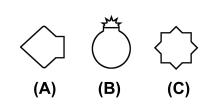
The background shapes as adorned on Royal Air Forcefulness shipping to denote the blazon of role operated past that particular squadron;
A) Fighter/Fighter Reconnaissance,
B) Bomber/Torpedo Bomber,
C) General Reconnaissance/Army Co-operation[46]
1 of the first squadrons to exist awarded their badge was No. 18 Squadron, who had a winged white pegasus every bit their insignia which dated dorsum to the First World War. When the badge was approved in 1936, the pegasus had been redrawn with a more upright rearing opinion and was now painted in gules (which is the colour cherry in heraldry).[47] [48] No. 208 Squadron had been in Arab republic of egypt for 17 years when they asked for approval for their squadron bluecoat. Due to their motto of Vigilant and the nature of their work (ascertainment), they had been using the Eye of Horus as their squadron insignia. The Chester Herald informed the squadron that the utilize of an eye was considered unlucky in English Heraldry, so the squadron adopted the Giza Sphinx as their insignia instead. The badge was approved past King George VI in October 1937.[49] [l] Another squadron with associations in Arab republic of egypt was No. 45 Squadron, who had a winged camel on their badge. This represented the fact the squadron was equipped with Sopwith Camel aircraft in the First World State of war and its association with the Middle-East in the Second World State of war.[34] [51]
The bluecoat of No. 22 Squadron has a blood-red disc (torteaux) with a Maltese Cross and the symbol for pi. This is considering when No. seven Squadron and 22 Sqn were stationed together during the Beginning World State of war, 22 Sqn would accept off directly over the seven Sqn Lines (adaptation) and the fraction 22/vii approximates to pi.[52] No. 81 Squadron badge has a red star (mullet) of Russia as its insignia. The Russians awarded the squadron the star when they took Bell-ringer Hurricanes out to Murmansk to train the Soviet crews during the Second Earth State of war.[53]
Squadrons would often use insignia reflecting where they had served, RAF stations would more often than not use a local landmark or item particular to that area. RAF St Eval had a church in the middle of their badge (St Uvelus) which, when the airfield was being built, was under threat of sabotage.[54] It survived and became a repository for remembrance of fallen comrades. It also acted as a sign to crews that they were most home.[55] RAF Scampton's badge has a bow and arrow insignia. This represented the airfield (the arrow) and the moving of the A15 (the bow) so that the runway could be extended to x,000 anxiety (3,000 m)[annotation 5] [56] which necessitated the bow formation of the road at the eastern stop of the airfield.[57] [58] The station badge for RAF Waddington consists of a pocket-size function of Lincoln Cathedral, once more a focussing point for crews returning from active missions. The bluecoat was not approved until 1954 past Elizabeth II.[59]
Other stations had badges designed to reflect their office. In 1957, RAF Marham was awarded their new bluecoat which depicted a blue balderdash as its insignia and the motto of Deter. The motto indicated their base of operations'due south new role in the nuclear deterrent role and the bull symbolised that deterrence. The colour bluish is idea to have a been a nod towards the Blue Danube, the RAF's beginning atomic flop.[threescore]
Mottoes [edit]
Mottoes convey the spirit of the unit or squadron; for commands and training stations, this was commonly near what the intended output of that particular role was. Both Bomber and Fighter Commands had badges where the blazon and motto reflected that office. Bomber Command's motto was Strike hard, strike certain, whilst Fighter control had the motto of Offence defense force. Elements of both blazons and mottoes were included in the Strike Command badge that superseded both Bomber and Fighter Control when they were combined as Strike Command in 1968.[61] [62] No. 617 Squadron'southward motto is Après moi le déluge which translates from the French as "Subsequently me, the flood".[63] This reflected the reason that the squadron was created; to bomb the dams in the Ruhr Valley.[64] King George VI approved the badge for 617 Squadron in March 1944, some 10 months subsequently the Dambusters Raid.[notation 6] [65] [66] Virtually mottoes are written in Latin or English, though other languages were used;
| Unit | Motto | Language | Translation | Notes |
|---|---|---|---|---|
| No. 14 Squadron | أنا نشر الأجنحة بلدي وابقي على وعد | Arabic | I spread my wings and keep my promise | [67] |
| No. 257 Squadron | Thay myay gyeeshin shwe hti | Burmese | Decease or Glory | [68] |
| No. 268 Squadron | Ajidaumo | Chippewa | Tail-in-the-air | [69] |
| No. i Squadron RAF Regiment | Cuneiform | Swift and sudden | [70] [71] | |
| No. 68 Squadron | Vždy připraven | Czech | Always fix | [notation 7] [72] |
| No. 3 Group RAF | Niet zonder arbyt | Dutch | Null without labour | [73] |
| RAF Cosford | Seul le premier pas coute | French | Only the kickoff is difficult | [74] |
| RAF Machrihanish | Airm a dhionadh na fairgeachan | Gaelic | Arms to defend the seas | [75] |
| No. 150 Squadron | Αιει Φθανομεν | Greek | Ever ahead | [notation eight] [76] [77] |
| No. 224 Squadron | Fidelle all' amico | Italian | Faithful to a friend | [note 9] [78] [79] |
| No. 185 Squadron | Ara fejn hu | Maltese | Wait where it is | [annotation 10] [eighty] [81] |
| No. 75 Squadron | Ake ake kia kaha | Maori | For ever and ever exist strong | [note 11] [82] [83] |
| No. 160 Squadron | Api soya paragasamu | Sinhalese | We seek and strike | [63] |
| No. 164 Squadron | Firmes Volamos | Castilian | Firmly we fly | [annotation 12] [84] [85] [86] |
| RAF Eastleigh | Shupavu na thabiti | Swahili | Tough and potent | [87] |
| RAF Pembroke Dock | Gwylio'r gorooewin o'r awyr | Welsh | To scout the west from the air | [88] |
No. 100 Squadron had their badge awarded in 1938 whilst posted to RAF Seletar[89] and opted to have the motto (Sarang tebuan jengan dijolok; "Never stir up a hornets nest") written in Malaysian.[90] [91] The squadron blazon was traditionally a skull and crossbones (which it retains on its badge) with the motto Blood and Bones. While the squadron was posted to RNAS Donibristle in Fife, they replaced the skull and crossbones motif with a bulldog and the motto Nemo me impune lacessit, ("No-one provokes me with impunity"),[92] but reverted to the old motif and motto before long after.[93] [94]

Other badges were also approved for locational reasons; No. 240 Squadron had a badge adorned with a Viking helmet and the motto of Sjo vordur lopt vordur which is Icelandic for "Guardian of the ocean and air". Badges were also approved for the squadrons in the non-UK range (IE squadrons in the 300–399 and 400–499 ranges - the Article 15 squadrons)[95] such as No. 330 Squadron who had a Viking Longship and the motto of Trygg havet, which was in Norwegian, accordingly enough, (as it was a Norwegian Squadron) meaning "Guarding the seas."[96] [97] [annotation thirteen] The badges canonical to Dominion (or Republic) crews would traditionally incorporate insignia with a connection to the homeland to which the crews flying the shipping belonged to. No. 266 (Rhodesia) Squadron had their badge approved in August 1941 with a Bateleur eagle and the motto of Hlabezulu which derives from Shona meaning "The stabber of the sky."[98] [99] Badges were issued to non-flight units such every bit the Republic of iraq Levies, who had a badge approved by Rex George Half-dozen in 1949 that had two crossed Khanjar as its insignia and the motto of Ready. [100] [101]
Heraldic terminology [edit]
The component elements of badges are described – with regard to stances, positions, actions, attitudes and tinctures (colours) – by the apply of heraldic blazon. The near mutual terms used are listed below.[102] For example, No. 102 Squadron badge (shown on the right) is described as "On a demi-terrestrial world azure & dark blueish a lion rampant guardant gules holding in the forepaws a bomb sable".[103]
| Heraldic term | Significant | Heraldic term | Meaning | Heraldic term | Meaning |
|---|---|---|---|---|---|
| Addorsed | Wings spread, back to back | Erased | Torn off (unremarkably at the neck) | Plate | White roundel |
| Affrontée | Full fronted | Fess(due east) | Horizontal partition or brandish | Potent | Crutch - oftentimes with four arms |
| Silvery | Metal - white or silver | Fimbriated | With an outline of a dissimilar tincture | Purpure | The colour purple |
| Azure | The color blue | Fracted | With fruit | Quadrate | Square on the junction of a cross |
| Base | At the bottom of the display | Guardant | Head towards the observer | Queued | Ii tails with the aforementioned root |
| Bend | Diagonal partition or brandish | Gules | The colour ruby | Rampant | Upright in profile with hind legs on the ground |
| Charged | Placed on | Injure | Bluish Disc | Sable | The colour black |
| Close | With closed wings | Issuant | Appearing from (to event) | Salient | A beast standing on its hind legs virtually to pounce |
| Conjoined | Joined together | Mask | Face of an animal affrontée | Saltire | A diagonal cantankerous |
| Couped | Neck cut off direct | Mullet | A five pointed star shape | Seax | Scimitar with a notch on the dorsum of the blade |
| Cubit Arm | An arm cut off at the elbow | Ogress | Circle, usually on a shield | Sinister | To the right (as you look at the badge) |
| Demi | Half | Or | Metallic - xanthous in color and represents gold | Torteaux | A red roundel |
| Dexter | To the left (as you await at the bluecoat) | Stake | Vertical partition or brandish | Vert | The colour green |
| Displayed | Subject is Affrontée, caput turned, wings and legs spread | Passant | Walking with three paws on the basis | Voided | The centre removed |
| Eradicated | Uprooted with the roots showing | Pile | Wedge shape | Volant | Flying horizontally |
Gallery [edit]
-

Badge in the floor at St Clements Danes
-

Inside St Clements Danes church; the blackness spots on the floor are the badges
-

-

-

-

Notes [edit]
- ^ Most units/squadrons and bases had their badges updated to the Queen's Crown sometime after her accession, (although in some cases many years elapsed before the badge was updated). Virtually of the flying units were disbanded later the Second World War, then their badges retained the King's Crown. Queen Elizabeth II promulgated an social club in October 1954 detailing that all current badges in use, and from that engagement on, were to employ the Queen's (or St Edward's) Crown.
- ^ This would also mean refusing badges if they did not come across with the standard or borrow on other already existing and approved badges. In 1937, 6 Squadron submitted their original badge, it was politely refused. It clashed with the design of the No. 1 Squadron badge and too had a number within the master trunk of the bluecoat; for squadrons, the number would go on the round frame.
- ^ The type of outer leaves besides denoted the country of origin; British units had laurel leaves, maple leaves for Canadian squadrons, protea flower for South Africa, Wattle for Australia and fern for New Zealand.
- ^ No. 600 Squadron instituted their ain badge in the early 1920s which was based upon the City of London arms with the addition of the RAF hawkeye to a higher place it. When the RAF Squadrons were advised to employ for their badges, the squadron causeless theirs would get through. The Inspector of RAF Badges would not agree to the RAF eagle being on the badge and suggested a Wren instead. The squadron did not like this and so the matter was forgotten about and the squadron carried on without a bluecoat. After many casualties and postings in the 2nd World State of war, the squadron was in North Africa with a new Commanding Officeholder (CO) who was unaware of the disagreement with the Inspector of RAF Badges. He applied for, and was approved, a badge with the sword and the crescent moon, which was signed by King George VI. After the war when the squadron was reformed, they reverted to using the old bluecoat. At dinner with the Queen (Queen Elizabeth The Queen Mother) when she became honorary Air Commodore, the squadron presented her with the "Dust-Cart Badge" and maintained that information technology was their official badge. The Queen promised to "have a give-and-take with the King about it." The Rex duly signed the 'old' badge and approved it (despite the credible apoplexy of the Chester Herald who maintained information technology was not heraldic), and and then the squadron has 2 badges. But the dust-cart badge is used, which has no motto similar 607 Squadron.
- ^ Delve, writing in The military airfields of Smashing United kingdom of great britain and northern ireland, East Midlands : Cambridgeshire, Derbyshire, Leicestershire, Lincolnshire, Nottinghamshire, states the extended length to be ix,000 feet (2,700 m).
- ^ Wg Cdr Gibson held a contest among the aircrew for a badge for the squadron. When the Rex and Queen visited the squadron, they were shown the 'proofs' and they both chose the same badge and information technology was duly despatched to the Chester Herald for blessing. The design was elementary, merely the original motto chosen was Apres nous le drench as uttered by Marie Antoinette, so it had a majestic connection. Unfortunately, the Chester Herald disapproved of the negative connotations of the original statement. It was changed to Apres moi le deluge which again, the Chester Herald disapproved of because a Greek philosopher had said it to prove selfishness. The aircrew, by now tired of the situation, politely informed the Chester Herald that the King had canonical the badge some months before, so the Herald was going against the Rex's wishes. Presently later, a letter of the alphabet arrived from the Herald stating that he had no idea that the King had approved the badge and that he did not desire to interfere with the King's prerogative. The description of the badge was; "On a roundel, a wall in fesse, fractured past iii flashes of lite-ning[sic] in pile and issuant from the breach, water proper."
- ^ Was reformed in 1941 with mostly Czechoslovak members
- ^ The squadron formed at Kirec, in what was Republic of macedonia, in 1918
- ^ The bluecoat is based upon the Arms of Otranto where the squadron was formed.
- ^ The badge was designed whilst the squadron was in Malta and the blazon of the dragon on the badge signifies the defence against the attacks on the island
- ^ The squadron was largely crewed by New Zealanders and had a Tiki (Maori lucky ornament) as its insignia. Was disbanded in 1945 but the badge, honours and squadron plate were transferred to the Royal New Zealand Air Force.
- ^ The squadron was paid for by members of the British departer community in Argentina. The squadron was crewed by mainly Argentine volunteers who had British ancestry. The motto and insignia were suggested past the Argentine Ambassador to Britain in 1942; the insignia is of a British lion with a sun ascension backside, to represent Argentina.
- ^ The Squadron was disbanded past the RAF in November 1945 and transferred to the Imperial Norwegian Air Force. The squadron still operates to date with the aforementioned motto (Trygg havet) but the insignia has changed. (No. 330 Squadron RNoAF)
References [edit]
- ^ "No.one School of Technical Preparation". RAF Heraldry Trust. Retrieved 27 Feb 2018.
- ^ Pine 1983, p. 41.
- ^ Smith, Maurice, ed. (12 November 1954). "RAF Bluecoat Altered". Flying. 66 (2, 390): 722. ISSN 0015-3710.
- ^ "The Purple Air Force Badge". www.raf.mod.uk . Retrieved 27 Feb 2018.
- ^ a b Finn, C J, ed. (2004). "A brief history of the Purple Air Force". Royal Air Force Air Publications (ane): 372. OCLC 69224300.
- ^ Dunne, Lynn (17 Dec 2007). "State of war Veteran sees red with replica Squadron Flag". www.raf.modernistic.uk . Retrieved 27 February 2018.
- ^ Ashworth 1989, p. 201.
- ^ "50 years ago: 1 June 1956". flightglobal.com. 30 May 2006. Retrieved 26 February 2018.
- ^ Ashworth 1989, p. 203.
- ^ Pitchfork 2008, p. 53.
- ^ Congden 1987, p. 52.
- ^ Philpott, Ian M. (2008). The Imperial Air Forcefulness : an encyclopedia of the inter-war years (i ed.). Barnsley: Pen & Sword Aviation. p. 133. ISBN978-1-84415-391-6.
- ^ a b "Naval, Military and R.A.F. Insignia - Higher of Arms". world wide web.college-of-artillery.gov.uk . Retrieved 23 February 2018.
- ^ Pitchfork 2008, p. 12.
- ^ Pitchfork 2008, p. 192.
- ^ Congden 1987, p. 55.
- ^ a b "Badges, Standards and Battle Honours". world wide web.rafweb.org . Retrieved 25 Feb 2018.
- ^ Smith 1974, p. ten.
- ^ "207 Squadron Majestic Air Force History - dwelling house page alt". www.207squadron.rafinfo.org.uk . Retrieved 6 March 2018.
- ^ "273 Squadron (Badge) (Hansard, 12 June 1996)". hansard.millbanksystems.com . Retrieved 27 Feb 2018.
- ^ "RAF Heraldry Trust, An update to the Trust Activities, August 1998". www.griffon.clara.net . Retrieved 27 February 2018.
- ^ Pine 1983, p. 95.
- ^ Legate, Bryan. "Heraldic Badges in the RAF | Weblog | RAF Museum". www.rafmuseum.org.great britain . Retrieved 26 Feb 2018.
- ^ "A brief history of the Imperial Air Force". Royal Air Forcefulness Air Publications (1): 373. 2004. OCLC 69224300.
- ^ "The Unit | 90 Signals Unit of measurement | Majestic Air Force". world wide web.raf.mod.uk . Retrieved 2 March 2018.
- ^ "New Air Cadet Formation Badges". www.raf.modern.uk . Retrieved 4 March 2018.
- ^ "St Clement Danes Fundamental Church Of The RAF | Imperial War Museums". www.iwm.org.britain . Retrieved 25 February 2018.
- ^ "In Brief". Flight. 30 May 1958. p. 755. OCLC 829719558.
- ^ Evans, John (2004). "11: Squadron Badges". The Sunderland : flying-boat queen. Pembroke Dock: Paterchurch Publications. p. 72. ISBN1-870745-13-2.
- ^ "RAF Club Art Collection". world wide web.rafclub.org.britain . Retrieved 27 Feb 2018.
- ^ "Insignia". Flight. 2 July 1936. p. 20. OCLC 829719558.
- ^ Jackson, Paul (1995). Royal Air Force (2 ed.). Shepperton: Ian Allan. p. 68. ISBN0-7110-2338-7.
- ^ Boutell, Charles (1983). Boutell's Heraldry. London: F. Warne. p. 173. ISBN0-7232-3093-five.
- ^ a b Delve, Ken (2009). "Appendix I: Boxing Honours and Gallantry Awards". The desert air strength in World War II : an operational and historical record of the 1st Tactical Air Force (one ed.). Barnsley: Pen & Sword Aviation. p. 221. ISBN978-ane-84415-817-one.
- ^ Cole, Heather Child ; with a foreword by A. Colin (1982). Heraldic design : a handbook for students (2 ed.). Baltimore: Genealogical Pub. Co. p. 125. ISBN0-8063-0071-X.
- ^ "Her Majesty The Queen Approves A Unit Badge For No 8 Raf Force Protection Wing Headquarters | The Insight Online". www.theinsightonline.co.uk. 17 August 2011. Retrieved 25 February 2018.
- ^ "Unit Badges | RAF Heraldry Trust". www.rafht.co.uk . Retrieved 23 February 2018.
- ^ Jackson, Paul (1995). Purple Air Force (2 ed.). Shepperton: Ian Allan. p. 66. ISBN0-7110-2338-vii.
- ^ Pino 1983, pp. nine–xiii.
- ^ "600 Squadron RAuxAF | Majestic Air Force". www.raf.mod.britain . Retrieved two March 2018.
- ^ Hunt, Leslie (1973). Xx-one squadrons. The history of the Purple Auxiliary Air Force, 1925-1957. London: Garnstone Press. pp. 43–66. ISBN0-85511-110-0.
- ^ Onderwater, Hans (1997). Gentlemen in blue : the history of No. 600 (City of London) Squadron Imperial Auxiliary Air Strength and No. 600 (City of London) Squadron Clan 1925-1995. London: Leo Cooper. p. 345. ISBN0-85052-575-6.
- ^ "600 Squadron's two badges". www.rafht.co.uk . Retrieved two March 2018.
- ^ Hunt, Leslie (1973). Twenty-one squadrons. The history of the Imperial Auxiliary Air Forcefulness, 1925-1957. London: Garnstone Press. p. 179. ISBN0-85511-110-0.
- ^ Gordon, J (10 November 1971). "607 Squadron; Usworth became base for flyers who won fame for their country". The Sunderland Echo. p. 8. ISSN 0963-8997.
- ^ a b "Squadron Badges". Flight. 6 Feb 1936. p. 155. OCLC 829719558.
- ^ Yoxall, John (27 Jan 1956). "No. 18 Squadron; a Bomber Command Unit with a Remarkable History". Flight. p. 109. OCLC 829719558.
- ^ "Chinook Centenary Specials Outcome". airshowspresent.com . Retrieved ane March 2018.
- ^ Ashworth 1989, p. 194.
- ^ Pitchfork, Graham (2016). "10: The Flying Shuftis". Forever Vigilant: Naval eight/208 Squadron RAF - a Century of Service from 1916 to 2016. London: Chow Street. pp. 79–fourscore. ISBN9781910690147.
- ^ "45 Sqn | RAF Heraldry Trust". www.rafht.co.britain . Retrieved 27 February 2018.
- ^ Congden 1987, p. 56.
- ^ Wright, Brian (26 June 2007). "Assistance sought in tracking downward ex-RAF man Tug". The Hartlepool Mail . Retrieved 2 March 2018.
- ^ "Cornish RAF station reunion is planned". Exeter Express and Echo. 22 September 2010. ProQuest 752075819.
- ^ Delve, Ken (2006). Southward-Western England : Channel Islands, Cornwall, Devon, Dorset, Gloucestershire, Somerset, Wiltshire. Ramsbury: Crowood. p. 227. ISBN1-86126-810-six.
- ^ Delve, Ken (2008). The military airfields of Nifty Great britain. Ramsbury: Crowood. p. 254. ISBN9781861269959.
- ^ "A base with a story to tell". Lincolnshire Echo. 7 September 2017. ProQuest 1936338091.
- ^ "Special guests touch downwards". Lincolnshire Echo. 31 August 2017. ProQuest 1934149400.
- ^ Bonner, Phil; Harrigan, Dave (27 March 2014). "Spire is a fitting tribute for the airmen glad to return to base: Plane speak". Lincolnshire Echo. ProQuest 1510610805.
- ^ Eden, Paul Eastward; Smith, Clare (2016). "100 Years of the Blue Bull". RAF Almanac Review 2017. Stamford: Fundamental Publishing: 27. ISSN 1758-9681.
- ^ Delve, Ken (2005). RAF bomber control 1936-1968 : an operational and historical tape. Barnsley: Pen & Sword Aviation. p. 2. ISBN1-84415-183-2.
- ^ Delve, Ken (2007). Fighter Control 1936–1968; an Operational and Historical Record. Barnsley: Pen & Sword. p. iv. ISBN978-i-84415-613-9.
{{cite book}}: CS1 maint: ignored ISBN errors (link) - ^ a b Pine 1983, p. 14.
- ^ "617 Squadron". world wide web.raf.mod.britain . Retrieved 25 February 2018.
- ^ Brickhill, Paul (1963). The Dam Busters (14 ed.). London: Pan. pp. 99–125. OCLC 603388299.
- ^ "DAMBUSTERS Ceremony TAIL Fine art REVEALED | Flypast". www.flypast.com. i Apr 2013. Retrieved 27 Feb 2018.
- ^ Pino 1983, p. 108.
- ^ "257 Sqn | RAF Heraldry Trust". rafht.co.united kingdom of great britain and northern ireland . Retrieved 31 August 2019.
- ^ Pino 1983, p. 6.
- ^ "No.1 Armoured Motorcar Company | RAF Heraldry Trust". www.rafht.co.uk . Retrieved 28 February 2018.
- ^ Pine 1983, p. 227.
- ^ Pine 1983, p. 262.
- ^ Pine 1983, p. 149.
- ^ Pine 1983, p. 212.
- ^ "Machrihanish | RAF Heraldry Trust". www.rafht.co.united kingdom of great britain and northern ireland . Retrieved 27 Feb 2018.
- ^ Pine 1983, p. 269.
- ^ Lake, Alan (1999). Flying units of the RAF : the ancestry, germination and disbandment of all flying units from 1912. Shrewsbury: Airlife. p. 231. ISBNone-84037-086-vi.
- ^ "224 Sqn | RAF Heraldry Trust". www.rafht.co.uk . Retrieved 5 March 2018.
- ^ Pino 1983, p. 74.
- ^ Philpott, Ian (2013). The birth of the Royal Air Force. Barnsley: Pen & Sword Books Ltd. p. 431. ISBN978-i-78159-333-2.
- ^ "185 Sqn | RAF Heraldry Trust". world wide web.rafht.co.united kingdom . Retrieved 6 March 2018.
- ^ "75 Sqn | RAF Heraldry Trust". world wide web.rafht.co.uk . Retrieved 5 March 2018.
- ^ Whitaker, Stuart (29 September 2016). "75 Squadron marks a century since its formation". NZ Herald . Retrieved 5 March 2018.
- ^ Pine 1983, p. 80.
- ^ "164 Sqn | RAF Heraldry Trust". www.rafht.co.uk . Retrieved 1 March 2018.
- ^ Mander, Simon (20 Oct 2017). "Argentina's secret WWII heroes award The Few". RAF News. No. 1429. p. 7. ISSN 0035-8614.
- ^ "Eastleigh | RAF Heraldry Trust". www.rafht.co.uk . Retrieved v March 2018.
- ^ Pine 1983, p. 94.
- ^ "No. 100 Squadron Altogether". Flying. 1 March 1957. p. 291. OCLC 829719558.
- ^ "100 Squadron". world wide web.raf.mod.uk . Retrieved 25 February 2018.
- ^ Pine 1983, p. 205.
- ^ Pine 1983, p. 148.
- ^ Smith, Maurice A, ed. (13 March 1959). "Ace of Spades". Flying. Vol. 68, no. two, 440. p. 356. OCLC 829719558.
- ^ Dancey, Peter G. (2003). The Mod RAF: the Royal Air Force into the 21st century. Bromley: Galago Books. p. 59. ISBN0-946995-70-ii.
- ^ Halley, James J. (1988). The squadrons of the Royal Air Forcefulness & Commonwealth 1918-1988. Tonbridge: Air-United kingdom. p. 10. ISBN0-85130-164-nine.
- ^ Pine 1983, p. 237.
- ^ Evans, John (2004). "XI: Squadron Badges". The Sunderland : flying-gunkhole queen. Pembroke Dock: Paterchurch Publications. p. 73. ISBNane-870745-13-2.
- ^ Cummings, Colin (2010). "Answering the Mother Country's Call". The Journal of the Imperial Air Force Historical Gild. Royal Air Strength Historical Society (49): 31. ISSN 1361-4231.
- ^ Pino 1983, p. 98.
- ^ Pine 1983, p. 195.
- ^ Witherow, Mickey (2010). "The RAF's Associated Overseas Ground Fighting Forces". The Journal of the Royal Air Forcefulness Historical Society. Imperial Air Force Historical Lodge (49): 31. ISSN 1361-4231.
- ^ Ashworth 1989, p. 215.
- ^ "102 Sqn | RAF Heraldry Trust". www.rafht.co.uk . Retrieved one March 2018.
Sources [edit]
- Ashworth, Chris (1989). Encyclopaedia of Modern Regal Air Strength Squadrons. Wellingborough: Patrick Stephens Limited. ISBNi-85260-013-6.
- Congden, Phillip (1987). Per Ardua Ad Astra: a Handbook of the Royal Air Force. Shrewsbury: Airlife. ISBN0-906393-89-2.
- Pine, L G (1983). A Dictionary of Mottoes . London: Routledge & Kegan Paul. ISBN0-7100-9339-10.
- Pitchfork, Graham (2008). The Royal Air Force Twenty-four hours by Day. Stroud: Sutton. ISBN978-0-7509-4309-3.
- Smith, Peter C (1974). Royal Air Force Squadron Badges. Cambridgeshire: Balfour. ISBN0-85944-012-5.
Further reading [edit]
- Holiss, B R. Knights of the heaven: the link between the heraldry and history of the Royal Air Force. Newport Pagnell: Enthusiast. OCLC 18359586.
External links [edit]
- RAF webpage with badges as links to electric current RAF Stations
- RAF Heraldry Trust
- RAF Museum webpage detailing 'spooky' badges for Halloween
- The story of No. 171 Squadron RAF and their badge, which ended upwards not being issued
Source: https://en.wikipedia.org/wiki/Heraldic_badges_of_the_Royal_Air_Force

Post a Comment for "How to Get a Argent Badge Again"